Showing posts with label V-belts. Show all posts

Monday, July 25, 2016

Quick-Link - Gates Emergency V-belt Solution

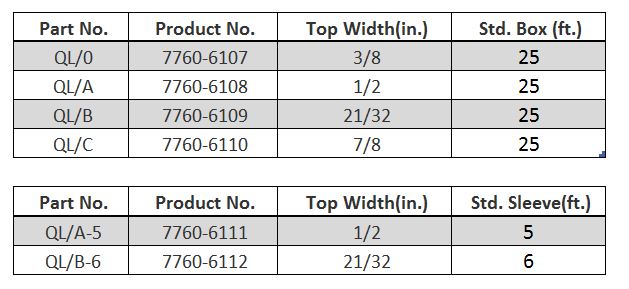
Unplanned drive downtime can be expensive.  However, stocking numerous replacement belt sizes can also be costly.  The Gates Quick-Link V-belt offers an alternative.  It can be quickly assembled by hand into whatever length you need.  

Quick-Link is available in the following sizes:


For a demonstration of the assembly process, watch our latest video:
Quick-Link


Tuesday, June 21, 2016

Understanding V-belt Construction Terms

V-belt construction features can be described by a variety of terms, which can cause confusion.  Here are some of the most common terms you may encounter:

  • Banded:
    • A fabric layer surrounds the belt
    • Also referred to as wrapped or covered
  • Bareback:
    • A type of banded V-belt where the fabric is not impregnated with rubber
    • Also referred to as low friction, dry cover, or clutching cover
  • Bandless:
    • No fabric surrounding the belt
    • Also referred to as cut edge, raw edge, or machined edge
  • Notched:
    • The bottom of the belt is notched (not flat)
    • Also referred to as cogged, molded notch, or cut notch
  • PowerBand®:
    • Multiple V-belt strands joined with a common backing
    • Also referred to as joined


Tuesday, May 31, 2016

Minimizing V-belt Drive Noise

To minimize the noise level of your V-belt drive, pay close attention to tension and alignment.

Improper V-belt tension can cause the belt to slip and squeal. Misalignment creates interference at the belt’s entry point into the sheave, resulting in a louder drive.

Information on proper belt installation tension and alignment is detailed in the V-belt manual:

HEAVY-DUTY V-BELT DRIVE DESIGN MANUAL


Thursday, June 19, 2014

A/B Multi-Duty® Sheave Use

Individual V-belts do not require exact groove spacing to properly operate. Therefore, both A and B-section single V-belts can be used with Gates Multi-Duty combination sheaves.

However, PowerBand® joined V-belts require very specific groove spacing for proper fit and operation. Gates Multi-Duty® combination sheaves use B-section groove spacing, making only B-section PowerBand V-belts compatible.

Sheaves that may be used with A-section PowerBand V-belts are available through Gates Made-to-Order Metals (www.gates.com/mtometals/).

Thursday, June 12, 2014

Belt Characteristics

When designing a power transmission system, it is important to consider the environmental conditions the belt will be exposed to.  This includes, but is not limited to; ambient temperatures, oil exposure, and static conductivity requirements.  These factors are often overlooked and can result in an otherwise appropriately designed system performing inadequately, not meeting the required specifications, or failing.  Below is a list of Gates standard line belt characteristics.  This should be used as a reference whenever a new belt drive is designed or the drive environmental requirements are in question.


For any additional questions feel free to contact us at ptpasupport@gates.com or 303-744-5800.

Wednesday, March 19, 2014

NEMA Minimum Sheave Diameters

When designing a new v-belt drive or troubleshooting an existing system, it is important to consider the NEMA (National Electric Motor Association) minimum sheave recommendations in cases where a NEMA motor frame is used or general guidelines need to be referenced.  These recommendations ensure that excessive force is not applied to the motor shaft and bearings which can cause decreased life, efficiency, and performance.


For any additional questions feel free to contact us at ptpasupport@gates.com or 303-744-5800.

Tuesday, January 3, 2012

Right from the Start - Belt Storage

To get the most from a belt drive, its important to properly store a belt -all the proper installation procedures and design practices can be for nothing if a belt is improperly stored or damaged in storage.

A few of the major belt storage guidelines:

1) Belts can be stored up to 6 years if properly stored at temperatures less than 85 degrees F, and less than 70% relative humidty.

2) Make sure the belts are not bent to diameters smaller than the minimum recommended diameter for that cross section.

3) V-belts can be stored by hanging on a wall rack if they are hung on a saddle or diameter at least as large as the minimum diameter recommended for the cross section. Don't hang from a pin or nail!

4) Don't store in direct sunlight.

5) Don't store near heating devices.

6) Don't store near ozone generating devices such as transformers or electric motors.

7) Don't store belts where they are or could be exposed to solvents or chemicals.

8) Don't store on the floor unless in a proctive container.

9) Don't crimp belts, either in storage or handling.

Complete guidelines can be found in the Gates Belt Drive Preventive Maintenance & Safety Manual.
Search This Blog