- Banded:
- A fabric layer surrounds the belt
- Also referred to as wrapped or covered
- Bareback:
- A type of banded V-belt where the fabric is not impregnated with rubber
- Also referred to as low friction, dry cover, or clutching cover
- Bandless:
- No fabric surrounding the belt
- Also referred to as cut edge, raw edge, or machined edge
- Notched:
- The bottom of the belt is notched (not flat)
- Also referred to as cogged, molded notch, or cut notch
- PowerBand®:
- Multiple V-belt strands joined with a common backing
- Also referred to as joined

GATES BELTS, HOSES, AND APPLICATIONS
Tuesday, June 21, 2016
Understanding V-belt Construction Terms
V-belt construction features can be described by a variety of terms, which can cause confusion. Here are some of the most common terms you may encounter:

Wednesday, June 8, 2016
Interchanging OEM Original Equipment V-belts With Standard Aftermarket V-belts
V-belts are commonly used in many
light duty type applications including outdoor power equipment (lawn mowers,
rotor tillers, snow blowers, etc.), light duty ventilation fans, power tools
(table saws, drill presses, wood lathes, etc.) and much more. V-belts eventually need to be replaced, and
obtaining appropriate replacements can be challenging.
OEM Originals
Replacement belts can nearly
always be obtained from the original equipment manufacturers, and this is usually
the best practice. OEM Manufacturers
often use belts that have been custom manufactured for them in special
constructions or in custom lengths that function best in their equipment. These special constructions are proprietary,
so the special features may not be easily determined.
Truflex and PowerRated Replacements
If original OEM V-belts cannot be
obtained, replacement belts can sometimes be identified dimensionally although
performance and functionality may not be the same as the OEM originals. When considering replacement belts from our
Truflex and PowerRated light duty V-belt product lines, there are additional considerations.
Clutching Applications
Clutching Applications
Some applications use belts to
provide a clutching function to engage and disengage the equipment. Only PowerRated type V-belts should be used in
these applications as they have been designed with a bareback type cover that
allows graceful slippage and aramid tensile cords that will not shrink like
Truflex V-belts when hot from slippage.
Using conventional Truflex V-belts could cause unsafe machinery
engagement and belt shrinkage could prevent disengagement, resulting in
potentially hazardous circumstances.
V-belt Length Variations
Standard Truflex and PowerRated
V-belts may not fit applications like OEM originals. Standard V-belts may be too short to easily
install or too long, resulting in adjustment pulleys moving to the end of their
travel and not able to apply sufficient belt installation tension. The position of spring loaded tensioning
pulleys may also change, resulting in an increase of decrease in the proper
belt tension.
PowerRated For Increased Robustness
Identically sized PowerRated V-belts
can sometimes be used in place of Truflex V-belts for added load capacity and
robustness. This can sometimes improve
belt service life when Truflex V-belt performance is less than desired. Truflex V-belts should generally not be
substituted for PowerRated V-belts, though.
Interchanging with Industrial V-belts
Identically sized Industrial
A-Section and B-Section V-belts can sometimes be used in place of Truflex
V-belts for added load capacity and durability.
Note, however, that small sheave diameters often used in these
applications may be too small for solid banded A-Section and B-Section
V-belts. AX-Section and BX-Section
(notched) V-belts are more flexible and tolerant of small sheave diameters, so
may perform better.
Summary
Identifying correct replacement belts for equipment can be challenging. We recommend that you consult original equipment manufacturers first for the best replacement. Then consider the functionality needed by the belt in selecting V-belts from our standard product lines. Contact Gates Product Application Engineering for further information at 303.744.5800 or ptpasupport@gates.com.
Identifying correct replacement belts for equipment can be challenging. We recommend that you consult original equipment manufacturers first for the best replacement. Then consider the functionality needed by the belt in selecting V-belts from our standard product lines. Contact Gates Product Application Engineering for further information at 303.744.5800 or ptpasupport@gates.com.
Tuesday, May 31, 2016
Will It Fit - GT2 Sprockets
What belt will fit into what industry standard sprocket is a question we regularly receive here in Product Application Engineering. Below is information regarding what Gates belts will fit into standard PowerGrip GT2 sprockets.


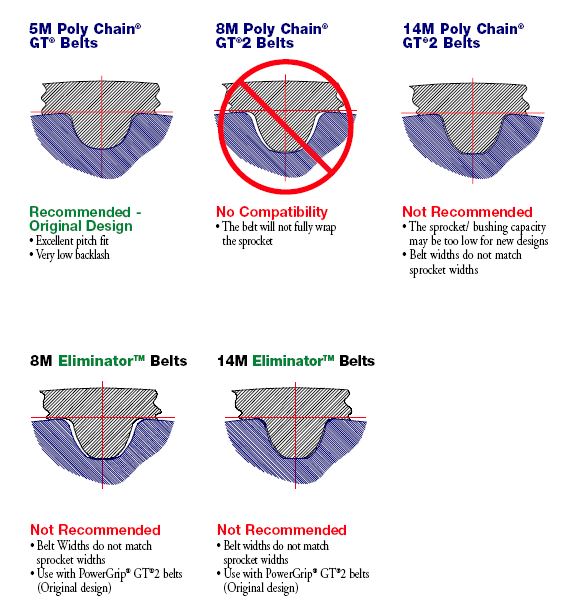
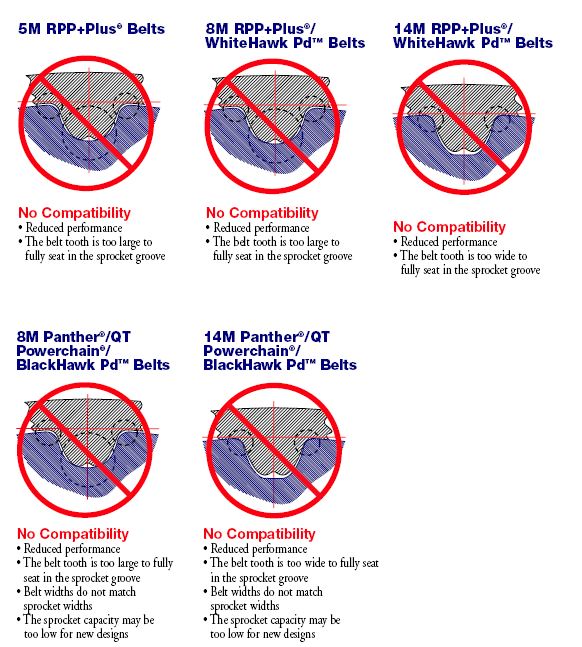
For any
additional questions feel free to look through our other blog topics or contact
us at ptpasupport@gates.com or
303-744-5800.
Minimizing V-belt Drive Noise
To minimize the noise level of your V-belt drive, pay close attention to tension and alignment.
Improper V-belt tension can cause the belt to slip and squeal. Misalignment creates interference at the belt’s entry point into the sheave, resulting in a louder drive.
Information on proper belt installation tension and alignment is detailed in the V-belt manual:
HEAVY-DUTY V-BELT DRIVE DESIGN MANUAL
Improper V-belt tension can cause the belt to slip and squeal. Misalignment creates interference at the belt’s entry point into the sheave, resulting in a louder drive.
Information on proper belt installation tension and alignment is detailed in the V-belt manual:
HEAVY-DUTY V-BELT DRIVE DESIGN MANUAL
Wednesday, May 4, 2016
Hose Cleanliness
Hose Cleanliness
When the
customer becomes more dependent on ISO standards, your
strategy needs to reflect a dedication to system
cleanliness.
What is
Hydraulic System Cleanliness?
liquid contamination found in hydraulic systems. “Contamination”
is defined
as any substance that is not part of the hydraulic system’s
working
fluid.
Why is
cleanliness important to your
customers?
There are several reasons:
Improved
control - spare
parts use can be controlled through preventive maintenance and
monitoring contamination.
Reduce
equipment downtime - through
scheduled inspections
failure for
increased life expectancy of components on equipment.
Reduced
repair cost - due
to fewer breakdowns.
Several
reputable sources have claimed that 70 to 80 percent of
hydraulic
system failures are due to contamination. By establishing
a contamination
control program, costly repairs and downtime may
be
minimized. A contamination control
program can be as simple
as
establishing an allowable level of contamination within a hydraulic
system,
supplying cleaned components for the system, and monitoring
levels of
contamination as part of a preventive maintenance
program.
Wednesday, April 27, 2016
Metric V-belt Lengths
Depending on the belt type and the manufacturer, metric V-Belt part number may specify different length measurements. The different belt lengths, abbreviations, and their relative positions in the belt are:

Gates classical Metric Power™ V-belts (e.g 10X, 13X, 17X) specify inside length in millimeters followed by”Li”. Narrow Gates Metric Power V-belts (e.g. SPZ, SPA, SPB, SPC) specify the datum/pitch length in millimeters.
Converting one length type into another may be required to identify if a proper replacement belt exists. The following table converts between any of the four length measurements. To find the correct equation, read the column headings across the top and choose the appropriate belt cross section. Read down the rows at the left and select the belt length type to calculate. Reading down the selected column and across the selected row, the box at the intersection lists the equations to convert from any of the other three length types.


Gates classical Metric Power™ V-belts (e.g 10X, 13X, 17X) specify inside length in millimeters followed by”Li”. Narrow Gates Metric Power V-belts (e.g. SPZ, SPA, SPB, SPC) specify the datum/pitch length in millimeters.
Converting one length type into another may be required to identify if a proper replacement belt exists. The following table converts between any of the four length measurements. To find the correct equation, read the column headings across the top and choose the appropriate belt cross section. Read down the rows at the left and select the belt length type to calculate. Reading down the selected column and across the selected row, the box at the intersection lists the equations to convert from any of the other three length types.

Tuesday, April 26, 2016
Using Extra Wide Driven Sprockets and Sheaves to Increase Bore Ranges
Hardware component selections for normal belt drives use the
same widths for both the driver and driven sprockets or sheaves. This
looks normal and works well most of the time.
But what if the driven shaft diameter is unusually large and
exceeds the bore range of the selected driven sprocket or sheave? One option is to re-design and select
hardware components with larger bore ranges.
Another option is to consider using a driven component in the same
diameter, but in a wider width than necessary.
For example, an 8MX-140S-12 sprocket uses a 2012 bushing
with a maximum bore of 2.125”. An
8MX-140S-21 sprocket uses a 2517 bushing with a maximum bore of 2.688”. In this case, just using a sprocket with a 21mm
face width instead of a 12mm face width will increase the sprocket bore range from
2.125” to 2.688”, which is considerable.
This principle can apply to other sprocket, pulley and sheave types as
well.
With synchronous belt drives there is no harm in using wider
driven sprockets so long as the driver sprocket is double flanged so the belt
is constrained appropriately on both sides.
A wider driven sprocket may look unusual, but will function just
fine. And the parallel sprocket
alignment isn’t as critical with the wider sprocket face width.
With V-belt drives there is no harm in using wider driven
sheaves. There may be some empty sheave
grooves in the wider driven sheave, but this will not pose any problems. Just be sure to accurately align the driver
sheave grooves with the driven sheave grooves that will contain V-belts.
For questions or further information, contact Gates Product
Application Engineering at 303-744-5800 or at ptpasupport@gates.com
Subscribe to:
Posts (Atom)